Showing posts with label pigs. Show all posts

Sunday, December 7, 2008

An Afternoon in the Life

It occurs to me that late afternoons are busy. Today was typical:

I took a bucket of spoiled fruit and veggies to the pigs around 4p, then got the goats out of the shed and helped them jump the electric fence. They wandered over to share the lettuce with the pigs while I went to the car and got some mulch hay for the little pig house. It's supposed to be cold, wind chill around -15. We really don't want the pigs to come down with pneumonia two weeks before the butcher makes it here.

The pig's water tub was frozen, so I flipped the ice out and poured an eight-gallon bucket of water into it. We threw some more grain and corn into a bucket and gave that to the pigs. With the goats and pigs occupied, we moved along to the chickens and other goats.

First thing is feeding the broilers, lifting a 50-pound sack of grain and dumping about a third of it into the feeder. I also refilled the watering fount and a five-gallon water bucket for the ducks, then gave everyone a scoop or two of loose whole corn. Lisa dumped about five pounds of lettuce into the pen, and we were done with the broilers.

(Hopefully, we'll be really and truly done with the broilers soon).

We got 18 eggs out of the laying henhouse and put grain in their feeder. We gave the Nigerian goats grain, fresh hay and water, and threw about 10 pounds of lettuce to the laying hens and turkeys. Then we cleaned up the Nigerian buck's hooves -- he's got problems with his feet -- and poured a bucket of water into the laying hens' waterer.

I went to the market to get a pig bucket and scooted by the grocery. By the time I made it back, Lisa retrieved the big goats from the pig pasture and milked the doe. She also gave them fresh hay, grain and water.

Time from start to finish? About an hour and 15 minutes. And that doesn't include shoo-ing the border collies out of the way periodically.

Monday, October 20, 2008

Mild Aggravation

Busy weekend. Started on the pig winter house. Lost the tape measure somewhere. Also lost the hose nozzle that goes to the pig pasture. And lost two chickens -- it looks like a fisher cat peeled back some of the poultry wire around the coop and killed them. I stapled it up as best as I could, but suspect I won't sleep too well tonight, listening for clucking roosters.

Gotten reacquainted with another book project tonight. More when there's a contract. I suspect I'd better sell books for pleasure before people start buying them for fuel.

Down into the 20s tonight. The cold is coming.

Tuesday, October 14, 2008

Harvesting

Harvesting potatoes, tomatoes, beans and carrots. While trying to keep goats out of harvest.

Taking goats for long walks. Fence charger blew up during the last storm. Enough voltage to keep pigs inside the pen (thank God) but not so great for goats.

Dealing with crazed tourists wanting more green eggs. I offered to hook them up to a battery charger to amp up production. They wanted to know if that would actually work.

Columbus Day Weekend. It's the second -- or maybe third -- craziest-making holiday of the year.

Wednesday, October 8, 2008

No. 300

A busy, busy month.

Bought the new goat. She's an Alpine, giving us about two quarts of milk every day. Will loves the stuff. John hates it. I saved up enough milk to make a two-pound wheel of goat's milk cheddar over the weekend that's ready for aging. I'll provide a report when it's ready.

Garden worked out OK. The corn was flattened by what was left of Hurricane Ike, but we have more than 100 pints of tomato sauce canned and ready to go. We've got about 50 pints of salsa verde with tomatillos and onions from the CSA. We've got about 50 pints of carrots and about 50 pints of green beans. We've got onions, scallions, blackberries, blueberries, peaches, nectarines, celery, broccoli, bell pepper, herbs and pesto in the freezer. We'll soon have 50 broilers -- they're getting huge -- and three pigs.

I'd say we're ready for winter, but not quite.

The chainsaw blew a piston, and fixing it ran about $200. I took a few days of vacation from the Day Job to finish up this week. The blade was getting a bit dull -- that'll happen when you pinch it in a tall beech tree, like I did -- so I took it to the shop for a quick sharpening. Turns out the replaced piston now needs replacing. Ack. Anyway, at this rate, I'll have our winter wood done by April or so.

We're certainly not ready for the Greater Depression.

But it's not winter just yet, nor has the Greater Depression totally kicked off. And it is gorgeous. The leaves are peaking in southern Vermont this week:


A nice story from this week's WSJ that reminds me I need to get off my ass:

Crash Survivor Scores Rare Triathlon Invite

Wall Street Exec Trains for Legendary Ironman Race

[A.C. Morgan] A.C. Morgan

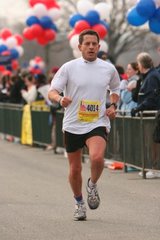
A.C. Morgan, seen during a triathlon in Rhode Island in July.

Ten years ago Mr. Morgan wasn't even sure if he'd ever walk again. A plane crash left him with two broken vertebrae in his neck and 30 percent of his body covered in burns. "I had a 50-50 shot at life," Mr. Morgan recalls. "I had to learn everything all over again -- how to brush my teeth, walk, go to the bathroom." Mr. Morgan's entire left arm was burned except for one spot. "I have a complete outline where my Timex Ironman watch was. It is the only spot on my arm where I have hair." The outline reminded Mr. Morgan of Timex's old ad, "It takes a lickin' and keeps on tickin'." He called the company to pitch himself as the subject of its next ad only to discover the campaign had been discontinued. But company representatives said if he ever wanted to do the Ironman he should call back. Mr. Morgan recalls thinking, "I can't even go to the bathroom by myself."

Before the accident Mr. Morgan had competed in sprint triathlons. After physical therapy he returned to the gym five or six days a week to lift weights and ride the Lifecycle bike for 30 minutes. In 2006, Mr. Morgan found himself listening to a client describing how he had competed in the Ironman and it made him remember the Timex offer. He wrote the company to retell his story of the plane crash and his watch "tattoo." In June 2007 he received a surprising call from Herbie Calves, Timex's vice president of sports marketing, asking whether he wanted an Ironman World Championship number for 2007 or 2008. He opted for 2008.

The 38-year-old Mr. Morgan, who co-manages U.S. equity sales trading at J.P. Morgan in New York, has since reprioritized his life to focus on training. He lives in Darien, Conn., and is married with two children. He stands 6-foot-1 and weights 180 pounds.

The Workout
Sponsorships allow many Ironman competitors to train full time. Mr. Morgan doesn't have that luxury. Before he began training for the race, he awoke at 4:30 a.m. to catch the 4:50 a.m. train to midtown Manhattan. Now, he wakes up at 3:20 a.m. three days a week to ride, run or swim for an hour before work. In January, Mr. Morgan hired a personal trainer who creates workouts he can download to his Blackberry. He can call her any time he has questions or needs motivation. "The other day I wasn't feeling the 22-mile run and she tells me, 'Think 22 miles plus 100% humidity on black lava.' I pay for that," he says. In addition to his morning workouts, he sometimes tacks on an additional run or bike ride after work, depending on what his trainer recommends.

On weekends, Mr. Morgan swims at his local YMCA and bikes 100 to 120 miles, followed by a 30- to 40-minute run. In bad weather, he puts his bike on a trainer so he can cycle inside while watching episodes of the HBO comedy "Entourage." According to the Ironman media guide, the average competitor trains between 18 and 30-plus hours per week: about seven miles per week swimming, 225 miles per week biking and 48 miles per week running. Mr. Morgan says his typical week sees him swim five miles, bike 150 to 170 miles and run 30 miles. To prepare himself for race day, he competed in two half-Ironmans, one in May and one in June.

Sample Workout

Mon. – Rest day

Tues.-Thurs. – 60-minute run, bike or swim

Sat. – Bike 120 miles followed immediately by a three-mile run.

Sun. – 20-mile run; swim.

Mr. Morgan hit a hurdle last October when he developed plantar fasciitis, a painful inflammation in the foot most often felt in the heel. "I can't get rid of it," he says. "You really have to walk away from [training] for it to heal, but I can't afford to." He goes to a doctor in the city once a week for laser treatment to break down the scar tissue and has also ordered custom orthotics for his sneakers. He stretches daily to ease the pain.

The Diet
Eating more and more often is Mr. Morgan's new dietetic challenge. "I could go home and eat a pint of Ben & Jerry's every night and still lose weight," he says. Mr. Morgan estimates that he has lost 15 pounds since he started training. To maintain his energy, he tries to eat every three hours. In the morning he has Raisin Bran topped with a banana and skim milk, followed by a cup of coffee and an energy bar. After his workout he has a recovery drink. He eats lunch at his desk, usually a turkey sandwich on whole wheat, which he orders in. "I probably eat chicken, vegetables and pasta seven nights a week, 365 days a year," he says.

Many athletes drastically change their diet during training. "I don't have free time to weigh everything and I'm not a bad eater," says Mr. Morgan, who instead paid Trismarter.com, a company that specializes in designing nutrition and exercise programs for triathletes, to create a diet plan specifically focused on the two days leading up to the race and the race day. He says it recommends hydrating every 10 minutes during the cycling portion. Mr. Morgan set his watch to beep every time he needs to rehydrate or refuel, ingesting calories from Gu, an energy gel, and Fig Newtons. During the run he ingests Gu every hour and drinks water or Gatorade at every mile marker.

The Cost
Tens of thousands of athletes try to get one of the coveted 1,800 spots through a lottery or by winning a spot at one of the qualifying events held around the world. "Spots are sold on eBay for up to $60,000," Mr. Morgan says. Timex covered the majority of Mr. Morgan's costs, including the $300 entry fee, and provided him with his jersey, hats, and a Timex team Trek bike.

Since January, Mr. Morgan has bought four pairs of running sneakers, costing between $80 and $110 per pair. After his wife pleaded with him, he also bought a new pair of cycling shoes, which he wears without socks. Triathlons are a gear geek's dream sport. "It's like a different version of golf," he says. "I could come home every day and go on one of 30 sites and buy a new water bottle holder or Gu or visor." Timex supplied Mr. Morgan with his bike, which could run from $3,000 to $20,000. He spends $250 a month on his personal trainer and paid $300 for his Trismarter.com nutrition evaluation. Membership at the YMCA is about $100 a month.

The Effort
Mr. Morgan says his biggest issue is time management. Making time for family and staying on top of his game at work have been a challenge. "I'm struggling to prioritize it all," he says. "My wife is so done with this." He works out at 4:30 a.m. on weekends to get in his training before his family wakes up. Mr. Morgan started at J.P. Morgan in June. "Any time you start in a new environment you have to prove yourself again," he says. "If I had been there six years it might be easier to take more luxury, but I pride myself on my work ethic and am one of the first people there in the morning."

The Benefit
Mr. Morgan's family and friends will join him in Hawaii to cheer him on. They are staying four days after the race to enjoy Hawaii. "I may not move the first two days," he jokes. Mr. Morgan says one of the professional triathletes gave him his best advice yet: "He told me the biggest waste is running down hard that last mile to the finish line. He wasn't telling me to walk but just to slow down and absorb it because I'm proving the impossible possible."

Write to Jen Murphy at workout@wsj.com

Wednesday, August 27, 2008

Getting My Goat(s)

Insanely busy day.

Up early this morning to clear out the rabbit shed and make room for goats. Worked in the morning.

Off at lunch to check the school bus schedule, pick up a pig bucket from the market and dicker with Gordon for fresh, local, organic wild blackberries. (My wholesale price is $3.75 for 10 ounces). Worked in the afternoon.

Wrapped up around 530p and headed to Springfield to get the girl La Mancha (Sheba) and boy Alpine (Heba). Brought them home. The border collies are in love with their new friends. The goats, not so much.

First day of school tomorrow. First fruit CSA pickup. Introducing goats to pigs. Blackberry delivery. Pick up some more pine shavings for the goat shed. Fix the pig watering bucket. Continued lots of work on the day job. It'll be a busy one.

Sunday, July 20, 2008

It's Been A While

Caramba! It's been a busy summer.

New bosses at work. Lots of things to plant, weed, harvest and feed. Fifty broiler chicks and 15 feather-footed bantams coming in the mail this week. Near-catastrophe avoided this morning; I chopped down about 100 pin cherry trees in the back pasture without knowing that they're toxic to pigs. Moved them before the leaves could wilt and pigs could get poisoned.

Going for an occasional run, but not so much lately. Hoping to take a week or so off soon and get firewood for the winter. Hoping to make more cheese; my first big cheese came out kind of dry, so we used it in the 42 servings of pesto that are now in the freezer, along with basil from the CSA, local sunflower seeds and olive oil.

Boys are being teen-age boys, skulking about at odd hours. Collies are being collies, skulking about at odder hours.

More later. It's just been Too. Damn. Busy.

Sunday, June 29, 2008

Cool Stuff

So I've not been posting for a while. Busy with work. Busy with children. Busy with garden and fruit trees and bushes and other life-like things. We regret the inconvenience, as they say, and to atone, here are some very cool things:

*** Dara Torres. The woman sounds like a complete emotional basket case, but good for her for making the Olympic team at 41 -- and good news for middle-aged sloggers (and we know who we are). As an aside, I'd like my abs back. It appears she stole them:


An excerpt from the story:

UPON HEARING THAT TORRES is likely to make the Olympic team at age 41, many people have the same question: How is this possible? Kinesiologists counter with a different query: Why are you so surprised? “Dara is extremely impressive, but she’s not as unique as people think,” says Michael Joyner, a competitive athlete and anesthesiologist at the Mayo Clinic who writes scholarly papers about aging and sports. “Ted Williams hit .388 when he was 39. Jack Foster did very well in the Olympic marathon when he was 40. Karl Malone earned a triple-double in an N.B.A. game at 40. Jeannie Longo won a French time-trial championship in cycling at age 47.” Torres’s events — short swims — are also well suited to competitors of advanced age. Compared to, say, running, swimming is more technique-intensive and produces fewer injuries. Sprints are also kinder to older athletes, in that strength falls off more gradually than aerobic power. In April, at 37, Mark Foster, a freestyle sprinter in England, came out of retirement and earned a spot, for the fifth time, on the British Olympic swim team. “For those of us who pay attention to this stuff,” Joyner said, “Dara’s performance is unusual but not totally unexpected.”

So why do we assume a middle-aged swimmer must be all washed up? Because for nonelite athletes, sporting achievements fall off precipitously with age. Body composition changes toward more fat and less muscle. Strength and aerobic capacity decrease as well. But a primary reason that athletic performance degrades in adulthood is changes in priorities. People tend to devote more time and energy to jobs and families than to sports. Even committed athletes downgrade their workout goals from achieving personal bests to staying in shape. Academics refer to this reduction in physical activity as hypokinesis. The phenomenon is not limited to humans. A 1985 study showed that rats with unlimited access to running wheels exercised less as they aged. “But look at people who maintain activity levels,” says Joel Stager, a professor of kinesiology at Indiana University. “It’s a different story! A lot of what we assume is aging is just progressive hypokinesis. How many people at Dara’s age have maintained their training consistently? I’m going to say there are very, very few.”

Even childbirth needn’t be a sports-career killer. In 1972, in The Journal of the American Medical Association, E. Zaharieva published a study of 13 women who were pregnant and then competed in the 1964 Olympic Games. Most resumed serious training between three and six months after giving birth. All said, Zaharieva wrote, “they became stronger, had greater stamina and were more balanced in every way after having a child.” Last September, Lindsay Davenport was back on the pro tennis tour and winning just three months after giving birth, while in November, Paula Radcliffe won the New York City Marathon less than 10 months after having a baby.

So how long can peak athletic performance last? Hirofumi Tanaka, the director of the Cardiovascular Aging Research Laboratory at the University of Texas at Austin, found that both elite and nonelite runners and swimmers could maintain personal bests until age 35, after which performance declined in a gradual, linear fashion until about age 50 to 60 for runners and 70 for swimmers. Deterioration was rapid from there. Tanaka also found that swimmers experienced more modest declines than runners and that swim sprinters, like Torres, experienced the smallest declines of all. At Yale University, Ray Fair, a runner and an economist, crunched statistics on aging and peak athletic performance and created what he calls the Fair Model. The model provides a table of coefficients that enable an athlete to take a personal-best time and compute how long he or she should expect to take to complete that same event at a specific point later in life (assuming he or she has continued to train at the same level). According to the Fair Model, a woman who swam a personal best 24.63 seconds in the 50-meter freestyle at or before age 35 should expect to clock 25.37 seconds at age 41. “I am struck by how small the deterioration rates are,” Fair wrote in a paper titled “How Fast Do Old Men Slow Down?” “It may be that societies have been too pessimistic about losses from aging for individuals who stay healthy and fit.”

*** Next. Russell Means profile in the Washington Post. Eh, Russell -- have your tribal people get with my tribal people and see who got screwed over first (and longest). And general note to the part of your frontal lobe that deals with PR issues: Don't call the white reporter a racist. At least, not before the story runs. Your Dolce and Gabbana shades will be mentioned.

At our first interview, over breakfast, Means was surly from the get-go. Within five minutes of shaking my hand, he accosted me for my "[expletive] white racist arrogance. There's only one reason you people came to this continent," he said. "Greed! We Indians have our spirituality. We have our land, but Americans have no culture except greed."

I changed the subject, asking Means how many Lakota backed his independence claim. "That's not germane," he barked. "In all my years of international relations, not once has anybody ever questioned my sovereignty. Even if I am only speaking for myself and my brother, and I'm not, my sovereignty exists. It's spelled out in the treaties."

Eventually, I'd learn that Means has only six or eight active Lakota supporters scattered throughout North and South Dakota. Many other Lakota quietly share his contempt for the U.S. government; some even long for a return to the hallowed days of Lakota independence. And, while Means won 46 percent of the vote when he ran unsuccessfully for Pine Ridge tribal chair in 2004, he has not endeared himself with his desperado-style secession.

*** Interesting Ben Stein column in the NYTimes on wage deflation and the price of oil. Wish it were all that simple, but it's a good point, nevertheless:

But the trend is dismal. The average private worker now earns very roughly $600 a week, not counting fringe benefits. For this worker, gasoline might well account for close to one-tenth of his or her earnings. If the price of gas goes up 25 percent, the effect is serious. To put it mildly, people making $600 a week do not have a lot of leeway on spending.

As I see it, the problem is not the price of oil generally. (I think that the price will decline somewhat before long, but the long-term trend is very much up.) The problem is the stagnation of wages. Please bear in mind that the numbers I gave are averages. Skilled workers make much more. Lawyers, doctors, investment bankers, accountants, dentists — they all make more. ( I just paid two dentists a total of more than $10,000 — I am not kidding — to have one poor old tooth get a root canal and a crown, and I’m not finished with that miserable tooth yet. I paid for 90 percent of it out of my own pocket. I do earn more than the ordinary citizen, but nothing by Wall Street standards.)

But, obviously, a heck of a lot of workers make less. Imagine what it means to minimum-wage workers for gasoline to surge past $4 a gallon.

What is to be done? The federal government can do little to make the price of oil fall in the short run, except, perhaps, for one basic thing: balance the budget. The world price of oil is denominated in dollars. The dollar is weak for many reasons, but a big one is the immense budget deficits run by our government. If President Bush and Senators John McCain and Barack Obama were to stand together in front of a camera and solemnly swear that they would balance the budget in four years, even if it required tax increases on people earning millions, the dollar would rise against the euro, and oil would fall in dollars.

*** Final cool things. Went by the co-op to get some cheese, and they were giving away Silk, which (I think) is basically soy milk. They were giving away a lot of it because it was close to expiration. So we got 35 gallons of free Silk. Bad news is, it's no good for cheese or ice cream. Good news is, the pigs love it.

Went by a flea market last week and found an extraordinarily sharp crosscut saw for $20. Also, a first-edition copy of "Remember the Alamo" by Robert Penn Warren. Sweet.

Youngest son made it to Arizona and back for the national youth leadership conference. Seemed to have a good time. Is still skeptical of adults in power. This is generally a Good Thing.

I'm off for a few days to get some serious day job stuff done.


Monday, June 16, 2008

This Just Kills Me.


From the Daily Mail:

Pig in Boots: The world's only porker who is afraid of mud

By Beth Hale
Last updated at 8:31 PM on 10th June 2008

You can't get much happier than a pig in muck, or so we are told.

But when this little piggy arrived in the farmyard she showed a marked reluctance to get her trotters dirty.

While her six brothers and sisters messed around in the mire, she stayed on the edge shaking. It is thought she might have mysophobia - a fear of dirt.

Owners Debbie and Andrew Keeble were at a loss, until they remembered the four miniature wellies used as pen and pencil holders in their office. They slipped them on the piglet's feet - and into the mud she happily ploughed.

Now she runs over to Mr Keeble so he can put them on for her in the morning.

Sunday, June 15, 2008

Busy. And Busy. And Very Busy.

No kidding. Haven't posted in forever.

Been to New York. Been to Boston. Bought rhubarb. Cleared out more garden for corn, beans and squash. Fixed chicken fence. Yelled at collies. Talked with boys. Planted blueberries. Got peach and pear trees. Found a free canner driving to the feed store. Built garden trellises. Worked on a book. Lots of day job stuff.

Since I don't have any pig pictures yet, here's a cool story until then:

A post-petroleum world
On this Andover farm, little worry about fuel or food prices


June 15, 2008

With gas at $4 per gallon, most people in New Hampshire can feel their wallets draining along with their car tanks. Not Nelson Lebo. He doesn't have a car. He's not worried about the cost of home heating oil either. And soaring food prices? Not much of a problem.

Lebo, 40, lives in a 1782 farmhouse in the woods of Andover that he has dubbed Pedal Power Farm. He heats it with wood cut from the property. He gets around on a bicycle. He grows much of his own food and buys locally otherwise. He gets his electricity from solar panels.

Lebo is no typical homesteader, content to stay tucked away in the woods, living off his land. He thinks he has ideas the rest of us could use. And he's ready to share them.

"I've been living in a post-petroleum world for the last 18 years," he said. "Everyone else is going to start living in a post-petroleum world next year."

Lebo has been a fixture in Andover since he was hired to run Proctor Academy's environmental program in 1991. He stopped working at the private school last year because of a herniated disk, but he still manages the organic gardens there. He was a part-time dorm parent this year.

But his teaching days are far from over. Let Lebo talk, and he will engage you for hours - he verges on ranting - about energy policy, American consumerism and the design principles around which he has built his life. One thing you won't hear much of is a holier-than-thou attitude.

Monday, May 26, 2008

Memorial Day Weekend

... a nice, three-day weekend. Lots of sun. Not so much rest. Cleared about 750 square feet of garden by hand, with the amount of potato-sized rocks getting steadily larger. Really didn't even need flat rocks for paths -- just tossed the dug-up rocks into the middle of the garden for a path. Bitch of a job, but I plugged away and listened to Bill McKibben's Wandering Home on the iPod to keep from going insane.

So far, the garden seems to be happy. The chard is going great guns, and the onions are shooting up. Carrots seem to have survived, broccoli, peas and kale are pushing up. Not sure about potatoes, tomatoes, bell peppers or melons, since they've just been planted. Next move is to put the Three Sisters -- beans, corn and squash -- into the just-cleared garden. If there's time to clear any more, it looks like we'll throw in some sunflowers and maybe more potatoes. You can never have enough potatoes.

The animals all seem happy. The collies are actually respecting the invisible fence. The tails on the pigs are getting curlier by the day, which I understand means that they're happy. Even the chickens are mellowing a bit.

Weekend was a real washout for a lot of the locals. The market where our eggs are sold was doing OK, not as good as last year, but OK. The rest of the area looked like a ghost town. I guess $4 gas will do that to a tourist economy.

All in all, it just felt like a nice calm day before a really wicked storm.

Friday, May 23, 2008

This is Obscene

You don't have to be Potter Stewart to call this one. Not. In. My. House. No freakin' way. It goes to the pigs, chickens or compost pile.


Published: May 18, 2008

Grocery bills are rising through the roof. Food banks are running short of donations. And food shortages are causing sporadic riots in poor countries through the world.

You’d never know it if you saw what was ending up in your landfill. As it turns out, Americans waste an astounding amount of food — an estimated 27 percent of the food available for consumption, according to a government study — and it happens at the supermarket, in restaurants and cafeterias and in your very own kitchen. It works out to about a pound of food every day for every American.

Grocery stores discard products because of spoilage or minor cosmetic blemishes. Restaurants throw away what they don’t use. And consumers toss out everything from bananas that have turned brown to last week’s Chinese leftovers. In 1997, in one of the few studies of food waste, the Department of Agriculture estimated that two years before, 96.4 billion pounds of the 356 billion pounds of edible food in the United States was never eaten. Fresh produce, milk, grain products and sweeteners made up two-thirds of the waste. An update is under way.

The study didn’t account for the explosion of ready-to-eat foods now available at supermarkets, from rotisserie chickens to sandwiches and soups. What do you think happens to that potato salad and meatloaf at the end of the day?

A more recent study by the Environmental Protection Agency estimated that Americans generate roughly 30 million tons of food waste each year, which is about 12 percent of the total waste stream. All but about 2 percent of that food waste ends up in landfills; by comparison, 62 percent of yard waste is composted.

The numbers seem all the more staggering now, given the cost of groceries and the emerging food crisis abroad.

Wednesday, May 21, 2008

Cold, Wet and Rainy

Only been able to plant one of the apple trees. Still waiting to take Lisa's tomato and pepper plants out of flats and put them into the ground. Also need to dig up another 300 to 500 square feet of garden. Here's how it works:

1. Break sod into squares with pitchfork
2. Pull big rocks from ground
3. Get on hands and knees, pull up sod
4. Pull big rocks from ground
5. Turn soil over with pitchfork
6. Pull big rocks from ground

See the pattern? Pre-Columbian gardening, that's us.

The pigs are cracking me up. They sleep late. When I go to look at them in the morning, they've usually burrowed under the hay, and all you can see are little curly pig tails sticking out of the hay. The really good news? They're eating less grain that I'd expected. They've been around a bit more than a week, and haven't gone through an entire bag.

(I expect that'll change).

They eat a ton of leaves off bushes, and they're doing very well with old veggies and fruits from the market. We went to pick up the pig bucket tonight, and were warned that we'll need to start making daily trips very soon, when watermelon and fruit sales pick up.

I'll hope they do, and not just for the piglets' sakes -- I worry that this is going to be a slow summer for folks who depend on tourists. Four dollar gas ain't nothing to sneeze at, and I don't think it's getting better any time soon. Saw a story today where some analysts said oil might get as high as $140 this year. Given that it's at $132 today -- up from $129 yesterday -- um, yeah. I think it might hit $140 at some point this year. Like, before Memorial Day.

Back to the piglets -- I'm wondering if I should introduce them to the collies. I'm not utterly stupid; I know that nothing good can come from this. But I just know that Stink in particular would enjoy playing with pigs.

Maybe it'd be a name thing.

Monday, May 19, 2008

I Don't Get Out Nearly Enough.

Duty called. Had to drive to Boston early this morning for the Day Job. Put on my coat and tie, and went out before leaving to check on the pigs. Saw three curly little tails sticking out of the hay and remembered, I needed to get them some corn.

Stopped by the feed store en route to Boston and picked up two bales of hay, two bags of chicken feed, and a bag of corn. Nothing unusual about this, other than throwing hay into the Outback while wearing a coat and tie.

Made it to the city without too much incident. Met up with a coworker who was a bit taken aback by a colleague with hay in the car. He probably doesn't live in Vermont, I thought. Stopped to get some fast-food on the way out of town (hey, I was starving). The guy at the window peered into the back of my car. "You raise cows or something?" he asked, genuinely puzzled. Certainly he doesn't live in Vermont, I thought. Stopped for gas in southern New Hampshire. Came back from grabbing a Coke to find four people standing around my car, wondering if my bike and kayak racks were somehow related to the hay in the back of the car. They confessed; they were tourists from Missouri.

Drove back into Vermont. Stopped for groceries. No one stared. Ran by the market to pick up a pig bucket -- I'm giving the local grocer a break on green eggs in exchange for a bucket of old fruits and veggies every day or two. Again, nothing unusual about a guy in a coat and tie with hay and animal feed in the back of the car (although I'm sure the pig bucket added a certain je ne sans quoi to an establishment owned by a British gentleman). Anyway, nothing to see here, folks, move along.

I guess the moral of the story is, people who don't live in Vermont are strange. Or something like that.

Speaking of people who don't live in Vermont. The blog has been getting a lot of attention from Texas, almost certainly due to the latest triathlon tragedy. One reader was concerned that I was blaming the guy who died. Well ... no. But I'm not hugely crazy about huge events. And I think it's simple math. Bigger the event, bigger the chances for trouble.

Just philosophically, I don't think everyone should be able to enter a triathlon. Or a marathon. I'm not even sure I shouldn't be banned as a menace to others for my swimming/flailing in the water. Not to be elitist, but I think the sport would mean more if there's a minimum bar. Not a hugely high, Boston Marathon-like one, mind you -- but a minimum, so nitwits like myself don't try to enter one when they're woefully out of shape and hurt themselves or others.

This is NOT to say that the Conroe triathlete who died was out of shape, or a danger to anyone. I don't know -- maybe if there hadn't been 1,000 other people in the water, something could have been done. Or not. I don't know. But I do know a lot of these events are just too damn big. That's all. I'm just sayin'.

I'll step off my soapbox now. It's hard to stay on the soapbox anyway, when the Wall Street Journal has this to say about your neighboring town:

BRATTLEBORO, Vt. -- Policeman Robert Perkins received a complaint the other day. A man was standing near the tourist information kiosk in this quaint New England village, in the nude.

Officer Perkins spotted the perp and issued a warning: Keep your clothes on, or risk a $25 ticket. The man "was unaware" that being naked in town was illegal, Officer Perkins says.

[Blackboard]1
Shefali Anand/WSJ
On a blackboard in downtown Brattleboro in November, some residents expressed their opinions against the ban on public nudity. NOTE: Some photos in this gallery include nudity.

In fact, until just a few months ago, public nudity was perfectly legal here -- as it still is in many Vermont towns. However, over the past two years, Brattleboro, pop. 12,000, has experienced sporadic outbreaks of naked bicycling, naked hula-hooping, and nakedness in general. That, in turn, triggered a period of civic navel-gazing, both literally and figuratively.

Last month's incident by the tourist kiosk was the first report of public nudity after months of wintry weather. But now that spring is in the air, Officer Perkins says, people are starting to wear less clothing. "We'll see if they take it all off," he says.

Brattleboro's troubles started in August 2006, when three young men went skinny-dipping in a swimming hole outside of town, then decided to see what would happen if they went into town and got naked there.

So the three headed to Harmony Parking Lot -- a popular hangout for kids just off Main Street -- and took off their clothes. "It was kind of a spur-of-the-moment thing," said Chris Corry, 20 years old and a member of the group.

... Love the Journal to death. Really. But "Brattleboro's troubles?" What the hell, it's Belfast or something? Summer=People take clothes off. Winter=People put them back on. No troubles here.

Chance of snow showers tonight, wind blowing like a damn Banshee out of the north. Damn, will it never end? At least I haven't yet planted the two apple trees or blueberry bushes I got over the weekend.

Sigh.

But a cool site here, the Farm-to-Consumer Legal Defense Fund. Here's hoping I never need them (and I probably won't, since I'm not selling or even producing raw milk). But knock on wood, anyway. And read Salatin's book, Everything I Want To Do is Illegal.

I'll shut up now.

Thursday, May 1, 2008

Pig Things

Got a call last night from a guy who can sell us three Yorkshire piglets, so I spent a couple of hours early this morning on the fenceline, trimming brush. I'll put the electric fence up this weekend and assemble a quick, pallet-shack for the beasts. Also have to get a trough and watering barrel. Lot of stuff to do.

On the goat front, the Southern Vermont Dairy Goat Association is right up the road from us. I've been doing some back-and-forth with them, and one of their members may be selling a couple of yearling goats. They wouldn't be ready for milking until fall, but ...

Need to rent a rototiller in the next week, too. We got flurries yesterday (!) and the last freeze shouldn't be for another couple of weeks, but we'll have to have everything in the ground by then. I've done just about enough hand tilling to last, oh, a lifetime.

Hoping to get back on the running track next week. Looks like physical terrorism is just about over.

A quick tip of the hat to Frances Bolles, Don's child (Don was the Arizona Republic reporter who was killed in 1976 by a car bomb planted by some major assholes, one of whom is 78 and asking for parole. And shouldn't get it). She's right about the cute little centerpiece in the Newseum:

She's married and has a son. She's a successful author and career development expert. Nearly 32 years have passed and still, at any moment, it's once again June 2, 1976. Like when she read that the recently opened Newseum in Washington, D.C., has her father's bombed out car on display.

“That is just grotesque,” Frances said. “I can't tell you what pain it is knowing that people are going to walk by and gawk. It reinforces the idea that my father is a footnote, and I rail against that. Over time, a victim is forgotten so that in something like a clemency hearing the focus goes to the person who is living rather than the person who was killed. My father was real. I don't want anyone to forget that.”

Back to the day job, aka making little rocks out of big rocks.
_uacct = "UA-1459002-1"; urchinTracker();