Showing posts with label read of the week. Show all posts

Saturday, March 28, 2009

15 in 1 Million

If I tri'd right now, I suspect I'd be one of these 15:

Study: Triathlons can pose deadly heart risks

By Marilynn Marchione, AP Medical Writer | March 28, 2009

ORLANDO, Fla. --Warning to weekend warriors: Swim-bike-run triathlons pose at least twice the risk of sudden death as marathons do, the first study of these competitions has found.

The risk is mostly from heart problems during the swimming part. And while that risk is low -- about 15 out of a million participants -- it's not inconsequential, the study's author says.

Triathlons are soaring in popularity, especially as charity fundraisers. They are drawing many people who are not used to such demanding exercise. Each year, about 1,000 of these events are held and several hundred thousand Americans try one.

"It's something someone just signs up to do," often without a medical checkup to rule out heart problems, said Dr. Kevin Harris, a cardiologist at the Minneapolis Heart Institute at Abbott Northwestern Hospital. "They might prepare for a triathlon by swimming laps in their pool. That's a lot different than swimming in a lake or a river."

He led the study and presented results Saturday at an American College of Cardiology conference in Florida. The Minneapolis institute's foundation sponsored the work and tracks athlete-related sudden deaths in a national registry.

Marathon-related deaths made headlines in November 2007 when 28-year-old Ryan Shay died while competing in New York in the men's marathon Olympic trials. Statistics show that for every million participants in these 26.2-mile running races, there will be four to eight deaths.

The rate for triathletes is far higher -- 15 out of a million, the new study shows. Almost all occurred during the swim portion, usually the first event.

"Anyone that jumps into freezing cold water knows the stress on the heart," said Dr. Lori Mosca, preventive cardiology chief at New York-Presbyterian Hospital and an American Heart Association spokeswoman. She had no role in the study but has competed in more than 100 triathlons, including the granddaddy -- Hawaii's Ironman competition.

Cold water constricts blood vessels, making the heart work harder and aggravating any pre-existing problems. It also can trigger an irregular heartbeat. On top of this temperature shock is the stress of competition.

"It's quite frightening -- there are hundreds of people thrashing around. You have to keep going or you're going to drown," Mosca said.

Swimmers can't easily signal for help or slow down to rest during swimming as they can in the biking or running parts of a triathlon, said Harris, who also has competed in these events. Rescuers may have trouble spotting someone in danger in a crowd of competitors in the lakes, rivers and oceans where these events typically are held, he added.

For the study, researchers used records on 922,810 triathletes competing in 2,846 USA Triathlon-sanctioned events between January 2006 and September 2008.

Of the 14 deaths identified, 13 occurred during swimming; the other was a bike crash. Autopsies on six of the victims showed that four had underlying heart problems. Two others had normal-looking hearts, but they may have suffered a fatal heart rhythm problem, Harris said.

A search of the Minneapolis registry and the Internet found four other triathlon-related deaths from 2006 through 2008 beyond those that occurred in the officially sanctioned events.

"While not a large risk, this is not an inconsequential number," Harris said.

Fundraising triathlons have enticed many runners to try to expand into areas like swimming, which they may not have learned to do very efficiently, to benefit particular charities, Mosca said.

"They're really recruiting people to do these events," she said. "It can be a recipe for disaster."

Doctors offer these tips to anyone considering a triathlon:

--Get a checkup to make sure you don't have hidden heart problems.

--Train adequately long before the event, including open-water swims -- not just in pools.

--Acclimate yourself to the water temperature shortly before a race, and wear a wetsuit if it's too cold.

--Make sure the race has medical staff and defibrillators on site.

----

On the Net:

Heart meeting: http://www.acc.org

American Heart Association: http://americanheart.org

Registry: http://www.suddendeathathletes.org

Tuesday, March 3, 2009

Sue Me, I'm Sad

Stuck in Town Meeting for most of the day. Sigh. Trying to get some work done. So far, it's two big and good votes (keep a penny tax for economic development in the Valley, much needed, and throw some money to the non-profit day care center by the library, also much needed).

Lot to do today. Lisa is basically half-handed after the second hand surgery, so I'm running amok. Lots of day job things to do, animals to feed, fires to keep going, meetings to endure, miles to run.

On a sad note: If you've ever driven across Texas for hours and hours and hours, you listened to Paul Harvey. And while you might not have agreed with everything he said, the man had a voice. Calming, even while you disagreed violently with him -- something you can't really can't say about most other talkers. Here's the top half of the NYTimes obituary:

Paul Harvey, who captivated millions of American listeners for nearly six decades with his homespun radio news reports and conservative commentaries, delivered nationally on weekdays in a stentorian staccato, died on Saturday at the Mayo Clinic Hospital near his winter home in Phoenix. He was 90.

Mr. Harvey, who lived in the Chicago suburb of River Forest, died with his family at his side, Louis Adams, an ABC Radio Networks spokesman, told The Associated Press. No cause was given.

Mr. Harvey, who joined ABC in 1951, was forced to suspend his broadcasts for several months in 2001 by a virus that weakened a vocal cord, but he returned to his Chicago studio and remained on the air until recently.

In his heyday, which lasted from the 1950s through the 1990s, Mr. Harvey’s twice-daily soapbox-on-the-air was one of the most popular programs on radio. Audiences of as many as 22 million people tuned in on 1,300 stations to a voice that had been an American institution for as long as most of them could remember.

Like Walter Winchell and Gabriel Heatter before him, he personalized the radio news with his right-wing opinions, but laced them with his own trademarks: a hypnotic timbre, extended pauses for effect, heart-warming tales of average Americans and folksy observations that evoked the heartland, family values and the old-fashioned plain talk one heard around the dinner table on Sunday.

“Hello, Americans,” he barked. “This is Paul Harvey! Stand byyy for Newwws!”

He railed against welfare cheats and defended the death penalty. He worried about the national debt, big government, bureaucrats who lacked common sense, permissive parents, leftist radicals and America succumbing to moral decay. He championed rugged individualism, love of God and country, and the fundamental decency of ordinary people.

“You can almost hear the amber waves of grain,” the comedian Danny Thomas told him.

Mr. Harvey was unapologetic. “I have never pretended to objectivity,” he once said. “I have a strong point of view, and I share it with my listeners. I have no illusions about changing the world, but to the extent that I can I’d like to shelter your and my little corner of it.”

He loved human-interest stories, and the one-liners he tacked on to them. “Nudists in Lakeland, Florida, are upset that outsiders are sneaking a peek through a hole in their fence,” he intoned. “The police promise to look into it.”

Or: “A man called the I.R.S. and asked if birth control pills could be deducted. The I.R.S. worker, not missing a beat, came back and said, ‘Only if they don’t work.’ ”

Or: “White House occupants come and go. They are just like diapers. They should be changed often, and for the same reasons.”

In a format virtually unchanged over the years, his style was stop-and-go, with superb pacing and silences that rivaled Jack Benny’s. He spoke directly to the listener, with punchy sentences, occasional exclamations of “Good heavens!” or “Oh, my goodness!” and pauses that squeezed out the last drop of suspense: the radio broadcaster’s equivalent of the raised eyebrow or the knowing grin.

He was a wordsmith, too, banging scripts out on a typewriter, and rightly or wrongly was credited with inventing the terms “Reaganomics,” “skyjackers,” and “guesstimate.” Listeners came to expect stock cues: “Stay tuned for the rest of the story,” and “May I have your undivided attention for just a moment.”


Friday, November 7, 2008

The End Is Near

Root cellaring in New York? The end, indeed, must be near ...

November 6, 2008

Food Storage as Grandma Knew It

IN a strictly technical sense, Cynthia Worley is not transforming her basement into a time machine. Yet what’s going on this harvest season beneath her Harlem brownstone on 122nd Street, at Adam Clayton Powell Jr. Boulevard, is surely something out of the past — or perhaps the future.

The space itself is nothing special: Whitewashed granite walls run the width and depth of the room, 16 feet by 60 feet. A forgotten owner tried to put in a cement floor, but the dirt, which takes a long-term view of things, is stubbornly coming back. “It’s basically a sod floor,” Ms. Worley said.

What’s important is that the shelves are sturdy, because Ms. Worley and her husband, Haja Worley, will soon load them with 20 pounds of potatoes, 20 pounds of onions, 30 pounds of butternut and acorn squash, 10 heads of cabbage, 60-odd pints of home-canned tomatoes and preserves, 9 gallons of berry and fruit wines, and another gallon or two of mulberry vinegar.

The goodies in the pint jars and the carboys come from the Joseph Daniel Wilson Memorial Garden, which the Worleys founded across the street. The fresh produce is a huge final delivery from a Community Supported Agriculture farm in Orange County, which they used all summer. Packed in sand and stored at 55 degrees, the potatoes should keep at least until the New Year. The squash could still be palatable on Groundhog Day, and the onions should survive till spring. Ms. Worley, who counsels and teaches adults for the New York City Department of Education, and Mr. Worley, a neighborhood organizer and radio engineer, will let their basement-deprived friends store vegetables, too.

The Worleys, like a number of other Americans, have made the seemingly anachronistic choice to turn their basement into a root cellar. While Ms. Worley’s brownstone basement stash won’t feed the couple through the winter, she said, “I think it’s a healthy way to go and an economical way.”

According to a September survey on consumer anxieties over higher fuel and food prices from the Leopold Center for Sustainable Agriculture at Iowa State University in Ames, 34 percent of respondents said that they were likely to raise more of their own vegetables. Another 37 percent said they were likely to can or freeze more of their food. The cousin to canning and freezing is the root cellar.

Thursday, November 6, 2008

Not So Much in Vermont

Back from a week in Texas, helping out the father. Long story, but he's OK. In my absence, Lisa acquired two Nigerian dwarf goats, which are excellent for cheese. Well, the doe is great; the buck probably won't be much help, unless I want to market Stink-to-High-Heaven cheese to the masses. We'll use him as a breeder, I'm thinking.

Too much catching up to do. But I was charmed by this NYTimes piece today. It's true; I used to run in the city and was always amazed when I made it home safely. Even in Central Park. Never got beaned with a Krispy Kreme, though:

November 6, 2008
FITNESS

Road Runner Rage

JEAN KNAACK couldn’t keep a lid on it. While on a six-mile run near her home in Maryland, she raised her water bottle and expelled its contents onto the passenger-side window of a car.

Ms. Knaack, a 115-pound runner, had been jogging on the sidewalk when the vehicle had come within inches of hitting her. The driver had blindly pulled out of an adjacent parking lot, and Ms. Knaack responded with the aggressive squirt, coupled with a few choice expletives.

She did not anticipate what happened next.

The driver pulled the rest of the way out of the parking lot and into the street, whipped around in an intersection, got out of the car, and confronted her. Amid of flurry of profanities, the motorist threatened to strike her with a beer bottle. “The fact that he was so specific really scared me,” she said. “My heart rate shot sky high. I felt like I was going to pass out.”

Even though Ms. Knaack was a seasoned runner — she’s the executive director of the Road Runners Club of America — and is knowledgeable about proper training technique and nutrition, she never got the memo on what do when an angry or negligent motorist takes a workout sideways. That’s because there really isn’t one.

While road rage between cyclists and motorists has drawn some attention lately, adversity has long existed between runners and motorists “on a low level,” says Brent Ayer, the head running coach at Hood College in Frederick, Md., who, years back, was pelted with a jelly doughnut while running.

Not that it’s always the driver’s fault. “I watch runners cut through intersections, cross in the middle of the street, and crowd cars,” Mr. Ayer said. “We are not entirely blameless.”


Friday, September 19, 2008

Is It Just Vermont People?

We're off to look at another goat this weekend. But here's something interesting from today's Wall Street Journal ...

For every person paralyzed by fear or blissfully in denial, there was another leaping into action to preserve what amounted to the fruits of a lifetime of work.

Carolyn Sloane, a 43-year-old paralegal in Wallingford, Vt., officially marked the end of the bull market by investing in cows. Ms. Sloane has been playing the stock market since 1989, but the rattling of Wall Street, she said, gave her a "desire for hard assets." She recently sold all of her stocks and bailed out of mutual funds, and put part of the money in certificates of deposit. But she also wanted the kind of assets she could see in her own yard, so she bought three cows, two of which were delivered on Sunday.

"This is my commodity play," she told perplexed relatives.

Her plan is to breed the cows, black-and-white Belted Galloways.

"When they have offspring, that's your dividend."

Friday, September 5, 2008

It Seems Appropriate

Just had to cut-and-paste this quote from a blog:

"The four verbal nonvirtues are lying, divisiveness, harsh speech, and
senseless speech."

-- The Dalai Lama

Thursday, August 28, 2008

Wowzers.

Puts my little issues into perspective, no?

August 29, 2008
U.S. Open ’08
Triathlete? Ball Girl? Amputee? All of the Above.
By JOSHUA ROBINSON


After every few dashes across Court 14, Kelly Bruno reached down to her right leg and flicked at something. It was a gesture so slight and so fleeting, she could have been swatting away a bug. It was also the only thing she did that was not in the protocol for a United States Open ball girl — nowhere does it mention popping the pressure valve on a prosthetic leg.

Bruno was born with several defects in her right leg and has been an amputee since she was 6 months old. By 18, she had turned herself into a track star among disabled athletes, with her own sponsorship deals. And as a world-class triathlete and Ironman competitor, she has raced in some of the most grueling events on the planet.

Now, at age 24, Bruno has scaled back her training for three weeks to shuttle back and forth across a courts at the Billie Jean King National Tennis Center to scoop up balls at the net. In a job done correctly only by those who are barely noticed, Bruno has stood out by blending in.
“It’s definitely harder than I expected,” she said, flashing an easy smile. “For me the running is not as tiresome, but I didn’t think standing was going to be so exhausting.”


This coming from a woman who began her journey to the Open after a brutal 0.9-mile swim in jellyfish-laden waters, a 24.9-mile bike ride and a 6.2-mile run at the sun-baked New York City Triathlon in June. John Korff, the triathlon’s organizer and a member of the United States Tennis Association board of directors, suggested that she try out to be a ball girl to give disabled athletes more exposure.

Wednesday, August 13, 2008

No Country for Middle-Aged Men

... just watched "No Country for Old Men" on DVD.

Wow. I'm having West Texas flashbacks.

Thursday, July 31, 2008

I'm Not The Only One Who Thinks This Is Weird.

From today's NYTimes:

Deaths Draw Attention to Triathlon Swim

Sonny Tumbelaka/Agence France-Presse — Getty Images

Participants of the Indonesian Triathlon in June.

Article Tools Sponsored By
Published: July 31, 2008

WHEN 60-year-old Donald Morehouse and 52-year-old John Hobgood Jr. died in different triathlon events last weekend, they became at least the seventh and eighth triathletes to die during competition this year. Those deaths came just one week after Esteban Neira, 32, died during the New York City Triathlon.

While this does not imply an epidemic — triathlon deaths remain rare — the deaths do share a puzzling resemblance: Like all of the triathlon deaths recorded by USA Triathlon at its sanctioned events in the last two years, they happened during the swim portion of the event, which also includes biking and running.

It is always striking when an athlete dies during an endurance competition, especially a young or well-conditioned athlete presumed to be at the peak of fitness. When Ryan Shay, a 28-year-old marathon champion, collapsed and died during the Olympic marathon trials last fall, even his closest friends and family were shocked. (Tests later determined his death was brought on by an irregular heartbeat that stemmed from an enlarged and scarred heart.)

But what makes the triathlon deaths more mysterious is that they all occurred during the first part of the race. Deaths during marathons tend to be more evenly distributed over the course of the 26.2 miles, with the largest grouping in the last mile, said Dr. William Roberts, a professor of family medicine at the University of Minnesota Medical School and the medical director of the Twin Cities Marathon, who has studied marathon deaths in the United States.

An initial autopsy on Mr. Neira was inconclusive, and the New York City Medical Examiner’s office is awaiting further test results. The death of Mr. Morehouse, at the Spudman Triathlon in Burley, Idaho (an event not sanctioned by USA Triathlon), was ruled an accidental drowning after an initial autopsy, said Scott Slaymaker, the chief executive of Slaymaker Group Inc., where Mr. Morehouse was a top executive. (The family did not want to pursue further tests, Mr. Slaymaker said.) Mr. Hobgood’s death, at the New Jersey State Triathlon, was also ruled an accidental drowning after an initial autopsy, said Lt. Carl Walsh of the West Windsor Township Police Department, with further toxicology results pending.

Hundreds of thousands have taken part in triathlons over the last four years, and with just 23 deaths recorded by USA Triathlon since 2004 (not including last weekend’s deaths), the timing could be a statistical anomaly. But this much is clear: 18 of those 23 deaths occurred during the swim.

“There have been some striking similarities among recent fatalities,” said Kathy Matejka, the director of event services at USA Triathlon, which does not track the number of triathlon participants. At least seven of those who died this year, she said, were men with “some measure of experience with the sport.”

Despite these similarities, a precise cause of death remains elusive in many cases. News reports suggest that at least three of this year’s deaths were linked to heart problems, but it is unclear whether those problems were primed to happen imminently or may not have happened until later without the race as a trigger.

No one knows why deaths are more common during the swim portion of triathlons, but researchers have some intriguing theories. Public accounts of this year’s fatalities indicate that the athletes seemed outwardly healthy, and in some cases autopsies turned up no obvious cause of death, such as blocked arteries.

The combination of apparent good health and a negative autopsy suggests a death caused by abnormal heart rhythms, said Dr. Pamela Douglas, a Duke University cardiologist who has studied triathletes.

Evidence suggests that swimming may trigger a certain type of cardiac arrhythmia caused by a genetic condition called long QT syndrome, said Dr. Michael Ackerman, a cardiologist and the director of the Windland Smith Rice Sudden Death Genomics Laboratory at the Mayo Clinic in Rochester, Minn. About 1 in 2,000 people are born with a heart condition that causes a glitch in the heart’s electrical system, and the most common of these is called long QT syndrome, after the tell-tale interval on an electrocardiogram.

The long QT heart recharges sluggishly between beats, setting up the potential for a skipped beat, Dr. Ackerman said. When the problem strikes, a heart’s electrical system can go haywire, degenerating into a possibly fatal arrhythmia.

Dr. Ackerman’s research team has identified several genetic forms of long QT, and one seems especially bothered by swimming, he said. He’s not sure why, but sees clues in a Japanese study several years ago that found that irregular heartbeats occur more commonly during swimming than during the same level of aerobic activity on land.

“It’s not that swimming is horrendously dangerous and running is not,” he said.

“We know that swimming is one of those triggers,” Dr. Ackerman said, “but it’s not going to be the absolute trigger.” An expert could detect most cases of long QT syndrome on an electrocardiogram, he said.

In any type of competitive racing situation, Dr. Douglas said, the adrenaline rush at the start could aggravate conditions like long QT syndrome, because adrenaline and its related hormones can make the heart more prone to arrhythmias. Physical exertion won’t create a heart problem where none existed, she said, but it can create problems for people with underlying cardiac disease.

Sudden fainting remains the classic warning sign of an underlying arrhythmia problem. “If you faint while running a race and your heart snaps back into sync 10 or 30 seconds later, you wake up,” Dr. Ackerman said. “If it happens in the water, even if your heart regains rhythm 30 seconds later, now you’re underwater.”

Many triathletes point to the swim as a triathlon’s most stressful segment. Most swims take place in open, often cold, water with hundreds or thousands of other swimmers vying for position. “Nothing can prepare a newbie for the start,” said Russ Evenhuis, a triathlete in Olympia, Wash. “It can be like jumping into a washing machine. You will get swum over, kicked, hit and banged into.”

A triathlon’s open-water swim hardly resembles the pools where most triathletes train, said Neil Cook, a New York City based triathlete and coach. “There is no wall 25 yards away, you can’t see the bottom and the 50 to 150 people around you are more than you’ve probably swam with in total during your training,” he said. “Oh, and you are wearing this wetsuit that’s tighter than a girdle.” Raise your heart rate and blood pressure under those conditions, he said, and “any weakness you have will become apparent.”

FABIAN QUESADA, 42, of Brooklyn prepared for the New York City Triathlon by taking part in an open-water training session with the Leukemia and Lymphoma Society’s Team in Training program. Still, he had a bout of anxiety his first time in open water. “Even though the wetsuit keeps you buoyant, it’s very restrictive, and you panic because it’s tight,” he said. “It can be an overwhelming experience.”

Triathlons normally brief participants on safety procedures, some of which are standard practice. For instance, “If you’re in the water and you have a problem, you’re supposed to stop and raise your hand,” said Dr. Doug Hiller, the chief medical officer for the International Triathlon Union, the sport’s worldwide governing body.

Ms. Matejka of USA Triathlon said her organization is committed to safety and will ask its experts to look for lessons in this year’s deaths, but as of yet, the group has no major changes planned.

“Speaking as a 20-plus-year triathlete, I wouldn’t change a thing,” said Andrew Hunt, the medical director for USA Triathlon.

“Do I think open-water swimming is inherently dangerous? No I don’t,” he said. Regarding the number of swim deaths, he said last week: “You can’t just look at the numerator, you have to look at the denominator — my guess is that that number is probably in the six figures. Six out of a hundred thousand isn’t that many.”

But no one really knows what the denominator is, because USA Triathlon does not keep records of race participants. While the number of USA Triathlon members has risen from 53,254 in 2004 to 100,674 in 2007, that doesn’t account for everyone who races because nonmembers can buy a one-day license for individual events.

There’s no way to regulate away risk, Dr. Hunt said, and some triathletes say that’s part of the appeal. “We want to push the limit of our comfort zone and experience life,” said Joe Bator, 37, of Boston. “Sure we want to minimize those risks,” he said. “But when it is time to race and put on that number, we need to be willing to push just a little bit more and get just a little bit more uncomfortable. If we don’t, we will never know what we are capable of achieving.”

Vicki Vila contributed reporting.

Monday, July 21, 2008

Takes a While to Get to the Point, But Gets There

Rolling Stone, doing some entertaining campaign coverage ...

It's a Class War, Stupid

Election season will be packed with distractions, but the real issue is becoming a matter of life and death

Matt Taibbi

Posted Jul 15, 2008 2:05 PM


I am a single mother with a 9-year-old boy. To stay warm at night my son and I would pull off all the pillows from the couch and pile them on the kitchen floor. I'd hang a blanket from the kitchen doorway and we'd sleep right there on the floor. By February we ran out of wood and I burned my mother's dining room furniture. I have no oil for hot water. We boil our water on the stove and pour it in the tub. I'd like to order one of your flags and hang it upside down at the capital building... we are certainly a country in distress.

— Letter from a single mother in a Vermont city, to Senator Bernie Sanders

The Republican and Democratic conventions are just around the corner, which means that we're at a critical time in our nation's history. For this is the moment when the country's political and media consensus finally settles on the line of bullshit it will be selling to the public as the "national debate" come fall.

If you pay close attention you can actually see the trial balloons whooshing overhead. There have been numerous articles of late of the Whither the Debate? genus in the country's major dailes and news mags, pieces like Patrick Healy's "Target: Barack Obama. Strategy: What Day is it?" in the New York Times. They ostensibly wonder aloud about what respective "plans of attack" Barack Obama and John McCain will choose to pursue against one another in the fall.

In these pieces we already see the candidates trying on, like shoes, the various storylines we might soon have hammered into our heads like wartime slogans. Most hilarious from my viewpoint is the increasingly real possibility that the Republicans will eventually decide that their best shot against Obama is to pull out the old "He's a flip-flopper" strategy — which would be pathetic, given that this was the same tired tactic they used against John Kerry four years ago, were it not for the damning fact that it might actually work again. (I'm actually not sure sometimes what is more repulsive: the bosh they trot out as campaign "issues," or the enthusiasm with which the public buys it.)

Naturally we'll also see the "Patriotism Gap" storyline whipped out and reused over and over again. There will also be much talk emanating from the McCain camp about "experience," although this line of attack will not be nearly as fruitful for him as it was for Hillary Clinton, mainly because the word "experience" in McCain's case also has a habit of reminding voters that the Arizona senator is, well, wicked old.

The Obama camp, playing with a big halftime lead as the cliché goes, is going to play this one close to the vest, sticking to a strategy of using larger and larger fonts every week for their "CHANGE" placards, and getting the candidates' various aides and spokesgoons to use the term "McCain-Bush policies" as many times as possible on political talk shows.

Obama will also use this pre-convention period to do what every general election candidate does after a tough primary-season fight, i.e. ditch all the positions he took en route to securing the nomination and replace them with opinions subtly (or sometimes not-so-subtly) reconfigured to fit the latest polling information coming out of certain key swing states. Both sides as well as the pundit class will describe this early positioning for combat over swing-state electoral votes as a "race for the center" (AP, July 3: "Candidates Courting the Center"), as if the "political center" in America were a place where huge chunks of the population tirelessly obsessed over semi-relevant media-driven wedge issues like stem-cell research and gay marriage, even as they lacked money to buy food and make rent every month.

The press, meanwhile, is clearly flailing around for a sensational hook to use in selling the election, as the once-brightly-burning star of blue-red hatred seems unfortunately to have dimmed a little — just in time, perhaps, to torpedo the general election season cable ratings. They are working hard to come up with the WWF-style shorthand labels they always use to sell electoral contests: if 2000 was the "wooden" and ?condescending? Al Gore versus the "dummy" Bush, and 2004 featured that same ?regular guy? Bush against the "patrician" and "bookish" John Kerry (who also "looked French"), in 2008 we?re going to be sold the "maverick" McCain against the "smooth" Obama, or some dumb thing along those lines. Time has even experimented with a "poker versus craps" storyline, feeding off the incidental fact that Obama is a regular poker player while McCain reportedly favors craps, which apparently has some electorally relevant meaning — and if you know what that something is, please let me know.

We're also going to be fed truckloads of onerous horseshit about the candidate wives. The Michelle Obama content is going to go something like this: the Fox/Limbaugh crowd will first plaster her with Buckwheatesque caricatures (the National Review cover was hilariously over-the-top in that respect) and racially loaded epithets like "baby Mama" (that via Fox News spokeswhore Michelle Malkin, God bless her) and "angry black woman" (via self-aggrandizing, cop-mustached Chicago-based prune Cal Thomas). Next, the so-called "mainstream" press, the "respectable" press, which of course is above such behavior, will amplify those attacks 10 million-fold via endless waves of secondary features soberly pondering the question of whether or not Michelle Obama is a "political liability" — because of stuff like the Thomas column, and Malkin's quip and the endless rumors about a mysterious "whitey" video. Cindy McCain, meanwhile, will generally be described as a political asset, as the pundit class tends to applaud, mute, stoned-looking candidate wives who have soldiered on bravely while being martyred by rumors of their mostly absent husband's infidelities. It will help on the martyrdom front that McCain launched his political career with her family money and drove her into an actual, confirmable chemical dependency. As long as she keeps gamely wobbling onstage and trying to smile into the camera, she's going to get straight As from the political press, guaranteed.

Some combination of all of these things is going to comprise the so-called "national debate" this fall. Now, we live in an age where our media deceptions are so far-reaching and comprehensive that they almost smother reality, at times seeming actually to replace reality — but even in the context of the inane TV-driven fantasyland we've grown used to inhabiting, this year's crude cobbling together of a phony "national conversation" by our political press is an outrageous, monstrously offensive deception. For if, as now seems likely, this fall's election is ultimately turned into a Swan-esque reality show where America is asked to decide if it can tolerate Michelle Obama's face longer than John McCain's diapers, it will be at the expense of an urgent dialogue about a serious nationwide emergency that any sane country would have started having some time ago. And unless you run a TV network or live in Washington, you probably already know what that emergency is.

A few weeks back, I got a call from someone in the office of Vermont Senator Bernie Sanders. Sanders wanted to tell me about an effort his office had recently made to solicit information about his constituents? economic problems. He sent out a notice on his e-mail list asking Vermont residents to "tell me what was going on in their lives economically." He expected a few dozen letters at best — but got, instead, more than 700 in the first week alone. Some, like the excerpt posted above, sounded like typical tales of life for struggling single-parent families below the poverty line. More unnerving, however, were the stories Sanders received from people who held one or two or even three jobs, from families in which both spouses held at least one regular job — in other words, from people one would normally describe as middle-class. For example, this letter came from the owner of his own commercial cleaning service:

My 90-year-old father in Connecticut has recently become ill and asked me to visit him. I want to drop everything I am doing and go visit him, however, I am finding it hard to save enough money to add to the extra gas I'll need to get there. I make more than I did a year ago and I don't have enough to pay my property taxes this quarter for the first time in many years. They are due tomorrow.

This single mother buys clothes from thrift stores and unsuccessfully tried to sell her house to pay for her son's schooling:

I don't go to church many Sundays, because the gasoline is too expensive to drive there. Every thought of an activity is dependent on the cost.

Sanders got letters from working people who have been reduced to eating "cereal and toast" for dinner, from a 71-year-old man who has been forced to go back to work to pay for heating oil and property taxes, from a worker in an oncology department of a hospital who reports that clinically ill patients are foregoing cancer treatments because the cost of gas makes it too expensive to reach the hospital. The recurring theme is that employment, even dual employment, is no longer any kind of barrier against poverty. Not economic discomfort, mind you, but actual poverty. Meaning, having less than you need to eat and live in heated shelter — forgetting entirely about health care and dentistry, which has long ceased to be considered an automatic component of American middle-class life. The key factors in almost all of the Sanders letters are exploding gas and heating oil costs, reduced salaries and benefits, and sharply increased property taxes (a phenomenon I hear about all across the country at campaign trail stops, something that seems to me to be directly tied to the Bush tax cuts and the consequent reduced federal aid to states). And it all adds up to one thing.

"The middle class is disappearing," says Sanders. "In real ways we're becoming more like a third-world country."

Here's the thing: nobody needs me or Bernie Sanders to tell them that it sucks out there and that times are tougher economically in this country than perhaps they've been for quite a long time. We've all seen the stats — median income has declined by almost $2,500 over the past seven years, we have a zero personal savings rate in America for the first time since the Great Depression, and 5 million people have slipped below the poverty level since the beginning of the decade. And stats aside, most everyone out there knows what the deal is. If you're reading this and you had to drive to work today or pay a credit card bill in the last few weeks you know better than I do for sure how fucked up things have gotten. I hear talk from people out on the campaign trail about mortgages and bankruptcies and bill collectors that are enough to make your ass clench with 100 percent pure panic.

None of this is a secret. Here, however, is something that is a secret: that this is a class issue that is being intentionally downplayed by a political/media consensus bent on selling the public a version of reality where class resentments, or class distinctions even, do not exist. Our "national debate" is always a thing where we do not talk about things like haves and have-nots, rich and poor, employers versus employees. But we increasingly live in a society where all the political action is happening on one side of the line separating all those groups, to the detriment of the people on the other side.

We have a government that is spending two and a half billion dollars a day in Iraq, essentially subsidizing new swimming pools for the contracting class in northern Virginia, at a time when heating oil and personal transportation are about to join health insurance on the list of middle-class luxuries. Home heating and car ownership are slipping away from the middle class thanks to exploding energy prices — the hidden cost of the national borrowing policy we call dependency on foreign oil, "foreign" representing those nations, Arab and Chinese, that lend us the money to pay for our wars.

And while we've all heard stories about how much waste and inefficiency there is in our military spending, this is always portrayed as either "corruption" or simple inefficiency, and not what it really is — a profound expression of our national priorities, a means of taking money from ordinary, struggling people and redistributing it not downward but upward, to connected insiders, who turn your tax money into pure profit.

You want an example? Sanders has a great one for you. The Senator claims that he has been trying for years to increase funding for the Federally Qualified Health Care (FQHC) program, which finances community health centers across the country that give primary health care access to about 16 million Americans a year. He's seeking an additional $798 million for the program this year, which would bring the total appropriation to $2.9 billion, or about what we spend every two days in Iraq.


"But for five billion a year," Sanders insists, "we could provide basic primary health care for every American. That?s how much it would cost, five billion."

As it is, though, Sanders has struggled to get any additional funding. He managed to get $250 million added to the program in last year's Labor, Health and Human Services bill, but Bush vetoed the legislation, "and we ended up getting a lot less."

Okay, now, hold that thought. While we're unable to find $5 billion for this simple program, and Sanders had to fight and claw to get even $250 million that was eventually slashed, here's something else that's going on. According to a recent report by the GAO, the Department of Defense has already "marked for disposal" hundreds of millions of dollars worth of spare parts — and not old spare parts, but new ones that are still on order! In fact, the GAO report claims that over half of the spare parts currently on order for the Air Force — some $235 million worth, or about the same amount Sanders unsuccessfully tried to get for the community health care program last year — are already marked for disposal! Our government is buying hundreds of millions of dollars worth of Defense Department crap just to throw it away!

"They're planning on throwing this stuff away and it hasn?t even come in yet," says Sanders.

According to the report, we're spending over $30 million a year, and employing over 1,400 people, just to warehouse all the defense equipment we don't need. For instance — we already have thousands of unneeded aircraft blades, but 7,460 on the way, at a cost of $2 million, which will join those already earmarked for the waste pile.

This is why you need to pay careful attention when you hear about John McCain claiming that he's going to "look at entitlement program" waste as a means of solving the budget crisis, or when you tune into the debate about the "death tax." We are in the midst of a political movement to concentrate private wealth into fewer and fewer hands while at the same time placing more and more of the burden for public expenditures on working people. If that sounds like half-baked Marxian analysis... well, shit, what can I say? That's what's happening. Repealing the estate tax (the proposal to phase it out by the year 2010 would save the Walton family alone $30 billion) and targeting "entitlement" programs for cuts while continually funneling an ever-expanding treasure trove of military appropriations down the befouled anus of pointless war profiteering, government waste and North Virginia McMansions — this is all part of a conversation we should be having about who gets what share of the national pie. But we're not going to have that conversation, because we're going to spend this fall mesmerized by the typical media-generated distractions, yammering about whether or not Michelle Obama's voice is too annoying, about flag lapel pins, about Jeremiah Wright and other such idiotic bullshit.

Bernie Sanders is one of the few politicians out there smart enough and secure enough to understand that the future of American politics is necessarily going to involve some pretty frank and contentious confrontations. The phony blue-red divide, which has been buoyed for years by some largely incidental geographical disagreements over religion and other social issues, is going to give way eventually to a real debate grounded in a brutal economic reality increasingly common to all states, red and blue.

Our economic reality is as brutal as it is for a simple reason: whether we like it or not, we are in the midst of revolutionary economic changes. In the kind of breathtakingly ironic development that only real life can imagine, the collapse of the Soviet Union has allowed global capitalism to get into the political unfreedom business, turning China and the various impoverished dictatorships and semi-dictatorships of the third world into the sweatshop of the earth. This development has cut the balls out of American civil society by forcing the export abroad of our manufacturing economy, leaving us with a service/managerial economy that simply cannot support the vast, healthy middle class our government used to work very hard to both foster and protect. The Democratic party that was once the impetus behind much of these changes, that argued so eloquently in the New Deal era that our society would be richer and more powerful overall if the spoils were split up enough to create a strong base of middle class consumers — that party panicked in the years since Nixon and elected to pay for its continued relevance with corporate money. As a result the entire debate between the two major political parties in our country has devolved into an argument over just how quickly to dismantle the few remaining benefits of American middle-class existence — immediately, if you ask the Republicans, and only slightly less than immediately, if you ask the Democrats.

The Republicans wanted to take Social Security, the signature policy underpinning of the middle class, and put it into private accounts — which is a fancy way of saying that they wanted to take a huge bundle of American taxpayer cash and invest it in the very companies, the IBMs and Boeings and GMs and so on, that are exporting our jobs abroad. They want the American middle class to finance its very own impoverishment! The Democrats say no, let's keep Social Security more or less as is, and let that impoverishment happen organically.

Now we have a new set of dire problems in the areas of home ownership and exploding energy prices. In both of these matters the basic dynamic is transnational companies raiding the cash savings of the middle class. Because those same companies finance the campaigns of our politicians, we won't hear much talk about getting private industry to help foot the bill to pay for these crises, or forcing the energy companies to cut into their obscene profits for the public good. We will, however, hear talk about taxpayer-subsidized bailouts and various irrelevancies like McCain's gas tax holiday (an amusing solution — eliminate taxes collected by government in order to pay for taxes collected by energy companies). Ultimately, however, you can bet that when the middle class finally falls all the way down, and this recession becomes something even worse, necessity will force our civil government — if anything remains of it by then — to press for the only real solution.

"Corporate America is going to have to reinvest in our society," says Sanders. "It's that simple."

These fantasy elections we've been having — overblown sports contests with great production values, decided by haircuts and sound bytes and high-tech mudslinging campaigns — those were sort of fun while they lasted, and were certainly useful in providing jerk-off pundit-dickheads like me with high-paying jobs. But we just can't afford them anymore. We have officially spent and mismanaged our way out of la-la land and back to the ugly place where politics really lives — a depressingly serious and desperate argument about how to keep large numbers of us from starving and freezing to death. Or losing our homes, or having our cars repossessed. For a long time America has been too embarrassed to talk about class; we all liked to imagine ourselves in the wealthy column, or at least potentially so, flush enough to afford this pissing away of our political power on meaningless game-show debates once every four years. The reality is much different, and this might be the year we're all forced to admit it.

Sunday, June 29, 2008

Cool Stuff

So I've not been posting for a while. Busy with work. Busy with children. Busy with garden and fruit trees and bushes and other life-like things. We regret the inconvenience, as they say, and to atone, here are some very cool things:

*** Dara Torres. The woman sounds like a complete emotional basket case, but good for her for making the Olympic team at 41 -- and good news for middle-aged sloggers (and we know who we are). As an aside, I'd like my abs back. It appears she stole them:


An excerpt from the story:

UPON HEARING THAT TORRES is likely to make the Olympic team at age 41, many people have the same question: How is this possible? Kinesiologists counter with a different query: Why are you so surprised? “Dara is extremely impressive, but she’s not as unique as people think,” says Michael Joyner, a competitive athlete and anesthesiologist at the Mayo Clinic who writes scholarly papers about aging and sports. “Ted Williams hit .388 when he was 39. Jack Foster did very well in the Olympic marathon when he was 40. Karl Malone earned a triple-double in an N.B.A. game at 40. Jeannie Longo won a French time-trial championship in cycling at age 47.” Torres’s events — short swims — are also well suited to competitors of advanced age. Compared to, say, running, swimming is more technique-intensive and produces fewer injuries. Sprints are also kinder to older athletes, in that strength falls off more gradually than aerobic power. In April, at 37, Mark Foster, a freestyle sprinter in England, came out of retirement and earned a spot, for the fifth time, on the British Olympic swim team. “For those of us who pay attention to this stuff,” Joyner said, “Dara’s performance is unusual but not totally unexpected.”

So why do we assume a middle-aged swimmer must be all washed up? Because for nonelite athletes, sporting achievements fall off precipitously with age. Body composition changes toward more fat and less muscle. Strength and aerobic capacity decrease as well. But a primary reason that athletic performance degrades in adulthood is changes in priorities. People tend to devote more time and energy to jobs and families than to sports. Even committed athletes downgrade their workout goals from achieving personal bests to staying in shape. Academics refer to this reduction in physical activity as hypokinesis. The phenomenon is not limited to humans. A 1985 study showed that rats with unlimited access to running wheels exercised less as they aged. “But look at people who maintain activity levels,” says Joel Stager, a professor of kinesiology at Indiana University. “It’s a different story! A lot of what we assume is aging is just progressive hypokinesis. How many people at Dara’s age have maintained their training consistently? I’m going to say there are very, very few.”

Even childbirth needn’t be a sports-career killer. In 1972, in The Journal of the American Medical Association, E. Zaharieva published a study of 13 women who were pregnant and then competed in the 1964 Olympic Games. Most resumed serious training between three and six months after giving birth. All said, Zaharieva wrote, “they became stronger, had greater stamina and were more balanced in every way after having a child.” Last September, Lindsay Davenport was back on the pro tennis tour and winning just three months after giving birth, while in November, Paula Radcliffe won the New York City Marathon less than 10 months after having a baby.

So how long can peak athletic performance last? Hirofumi Tanaka, the director of the Cardiovascular Aging Research Laboratory at the University of Texas at Austin, found that both elite and nonelite runners and swimmers could maintain personal bests until age 35, after which performance declined in a gradual, linear fashion until about age 50 to 60 for runners and 70 for swimmers. Deterioration was rapid from there. Tanaka also found that swimmers experienced more modest declines than runners and that swim sprinters, like Torres, experienced the smallest declines of all. At Yale University, Ray Fair, a runner and an economist, crunched statistics on aging and peak athletic performance and created what he calls the Fair Model. The model provides a table of coefficients that enable an athlete to take a personal-best time and compute how long he or she should expect to take to complete that same event at a specific point later in life (assuming he or she has continued to train at the same level). According to the Fair Model, a woman who swam a personal best 24.63 seconds in the 50-meter freestyle at or before age 35 should expect to clock 25.37 seconds at age 41. “I am struck by how small the deterioration rates are,” Fair wrote in a paper titled “How Fast Do Old Men Slow Down?” “It may be that societies have been too pessimistic about losses from aging for individuals who stay healthy and fit.”

*** Next. Russell Means profile in the Washington Post. Eh, Russell -- have your tribal people get with my tribal people and see who got screwed over first (and longest). And general note to the part of your frontal lobe that deals with PR issues: Don't call the white reporter a racist. At least, not before the story runs. Your Dolce and Gabbana shades will be mentioned.

At our first interview, over breakfast, Means was surly from the get-go. Within five minutes of shaking my hand, he accosted me for my "[expletive] white racist arrogance. There's only one reason you people came to this continent," he said. "Greed! We Indians have our spirituality. We have our land, but Americans have no culture except greed."

I changed the subject, asking Means how many Lakota backed his independence claim. "That's not germane," he barked. "In all my years of international relations, not once has anybody ever questioned my sovereignty. Even if I am only speaking for myself and my brother, and I'm not, my sovereignty exists. It's spelled out in the treaties."

Eventually, I'd learn that Means has only six or eight active Lakota supporters scattered throughout North and South Dakota. Many other Lakota quietly share his contempt for the U.S. government; some even long for a return to the hallowed days of Lakota independence. And, while Means won 46 percent of the vote when he ran unsuccessfully for Pine Ridge tribal chair in 2004, he has not endeared himself with his desperado-style secession.

*** Interesting Ben Stein column in the NYTimes on wage deflation and the price of oil. Wish it were all that simple, but it's a good point, nevertheless:

But the trend is dismal. The average private worker now earns very roughly $600 a week, not counting fringe benefits. For this worker, gasoline might well account for close to one-tenth of his or her earnings. If the price of gas goes up 25 percent, the effect is serious. To put it mildly, people making $600 a week do not have a lot of leeway on spending.

As I see it, the problem is not the price of oil generally. (I think that the price will decline somewhat before long, but the long-term trend is very much up.) The problem is the stagnation of wages. Please bear in mind that the numbers I gave are averages. Skilled workers make much more. Lawyers, doctors, investment bankers, accountants, dentists — they all make more. ( I just paid two dentists a total of more than $10,000 — I am not kidding — to have one poor old tooth get a root canal and a crown, and I’m not finished with that miserable tooth yet. I paid for 90 percent of it out of my own pocket. I do earn more than the ordinary citizen, but nothing by Wall Street standards.)

But, obviously, a heck of a lot of workers make less. Imagine what it means to minimum-wage workers for gasoline to surge past $4 a gallon.

What is to be done? The federal government can do little to make the price of oil fall in the short run, except, perhaps, for one basic thing: balance the budget. The world price of oil is denominated in dollars. The dollar is weak for many reasons, but a big one is the immense budget deficits run by our government. If President Bush and Senators John McCain and Barack Obama were to stand together in front of a camera and solemnly swear that they would balance the budget in four years, even if it required tax increases on people earning millions, the dollar would rise against the euro, and oil would fall in dollars.

*** Final cool things. Went by the co-op to get some cheese, and they were giving away Silk, which (I think) is basically soy milk. They were giving away a lot of it because it was close to expiration. So we got 35 gallons of free Silk. Bad news is, it's no good for cheese or ice cream. Good news is, the pigs love it.

Went by a flea market last week and found an extraordinarily sharp crosscut saw for $20. Also, a first-edition copy of "Remember the Alamo" by Robert Penn Warren. Sweet.

Youngest son made it to Arizona and back for the national youth leadership conference. Seemed to have a good time. Is still skeptical of adults in power. This is generally a Good Thing.

I'm off for a few days to get some serious day job stuff done.


Monday, June 16, 2008

This Just Kills Me.


From the Daily Mail:

Pig in Boots: The world's only porker who is afraid of mud

By Beth Hale
Last updated at 8:31 PM on 10th June 2008

You can't get much happier than a pig in muck, or so we are told.

But when this little piggy arrived in the farmyard she showed a marked reluctance to get her trotters dirty.

While her six brothers and sisters messed around in the mire, she stayed on the edge shaking. It is thought she might have mysophobia - a fear of dirt.

Owners Debbie and Andrew Keeble were at a loss, until they remembered the four miniature wellies used as pen and pencil holders in their office. They slipped them on the piglet's feet - and into the mud she happily ploughed.

Now she runs over to Mr Keeble so he can put them on for her in the morning.

Sunday, June 15, 2008

Busy. And Busy. And Very Busy.

No kidding. Haven't posted in forever.

Been to New York. Been to Boston. Bought rhubarb. Cleared out more garden for corn, beans and squash. Fixed chicken fence. Yelled at collies. Talked with boys. Planted blueberries. Got peach and pear trees. Found a free canner driving to the feed store. Built garden trellises. Worked on a book. Lots of day job stuff.

Since I don't have any pig pictures yet, here's a cool story until then:

A post-petroleum world
On this Andover farm, little worry about fuel or food prices


June 15, 2008

With gas at $4 per gallon, most people in New Hampshire can feel their wallets draining along with their car tanks. Not Nelson Lebo. He doesn't have a car. He's not worried about the cost of home heating oil either. And soaring food prices? Not much of a problem.

Lebo, 40, lives in a 1782 farmhouse in the woods of Andover that he has dubbed Pedal Power Farm. He heats it with wood cut from the property. He gets around on a bicycle. He grows much of his own food and buys locally otherwise. He gets his electricity from solar panels.

Lebo is no typical homesteader, content to stay tucked away in the woods, living off his land. He thinks he has ideas the rest of us could use. And he's ready to share them.

"I've been living in a post-petroleum world for the last 18 years," he said. "Everyone else is going to start living in a post-petroleum world next year."

Lebo has been a fixture in Andover since he was hired to run Proctor Academy's environmental program in 1991. He stopped working at the private school last year because of a herniated disk, but he still manages the organic gardens there. He was a part-time dorm parent this year.

But his teaching days are far from over. Let Lebo talk, and he will engage you for hours - he verges on ranting - about energy policy, American consumerism and the design principles around which he has built his life. One thing you won't hear much of is a holier-than-thou attitude.

Tuesday, May 27, 2008

Labels. Annoying and Silly Labels.

So, if you're concerned about peak oil, you've got to be a "survivalist."

Energy fears looming, new survivalists prepare

BUSKIRK, N.Y. (AP) — A few years ago, Kathleen Breault was just another suburban grandma, driving countless hours every week, stopping for lunch at McDonald's, buying clothes at the mall, watching TV in the evenings.

That was before Breault heard an author talk about the bleak future of the world's oil supply. Now, she's preparing for the world as we know it to disappear.

Breault cut her driving time in half. She switched to a diet of locally grown foods near her upstate New York home and lost 70 pounds. She sliced up her credit cards, banished her television and swore off plane travel. She began relying on a wood-burning stove.

"I was panic-stricken," the 50-year-old recalled, her voice shaking. "Devastated. Depressed. Afraid. Vulnerable. Weak. Alone. Just terrible."

Convinced the planet's oil supply is dwindling and the world's economies are heading for a crash, some people around the country are moving onto homesteads, learning to live off their land, conserving fuel and, in some cases, stocking up on guns they expect to use to defend themselves and their supplies from desperate crowds of people who didn't prepare.

The exact number of people taking such steps is impossible to determine, but anecdotal evidence suggests that the movement has been gaining momentum in the last few years.

These energy survivalists are not leading some sort of green revolution meant to save the planet. Many of them believe it is too late for that, seeing signs in soaring fuel and food prices and a faltering U.S. economy, and are largely focused on saving themselves.


And if you want to grow more of your own food, you must be a "localvore."

Growing the zero-mile diet

With fears of GMOs and widespread carbon guilt, cultivating your own veggies is poised to be the new competitive sport

VANCOUVER -- So you've bought into the 100-mile diet. Eco points to you. If you're looking for serious ethical kudos this season, however, you're going to have to dig even deeper - literally.

Serious locavores are working on a zero-mile diet, courtesy of the old-fashioned vegetable garden. As Canadians break ground in many parts of the country this month, concern over the carbon footprint of the global food trade is inspiring them to reach for their spades. And the hunger for a diet free of genetic modifications means the demand for organically grown and heirloom varieties has never been so great.

Dan Jason should know. The owner of Salt Spring Seeds has been promoting an intense local diet for 20 years from his home on British Columbia's Salt Spring Island. After he was interviewed by Vancouverites Alisa Smith and J.B. MacKinnon for their groundbreaking book, The 100-Mile Diet, Mr. Jason was struck with an idea.

"I thought, 'What is this 100-mile diet? We should be aiming for a zero-mile diet.' "

I'm just saying: Whatever happened to people? Yeesh.

Monday, May 26, 2008

Memorial Day Weekend

... a nice, three-day weekend. Lots of sun. Not so much rest. Cleared about 750 square feet of garden by hand, with the amount of potato-sized rocks getting steadily larger. Really didn't even need flat rocks for paths -- just tossed the dug-up rocks into the middle of the garden for a path. Bitch of a job, but I plugged away and listened to Bill McKibben's Wandering Home on the iPod to keep from going insane.

So far, the garden seems to be happy. The chard is going great guns, and the onions are shooting up. Carrots seem to have survived, broccoli, peas and kale are pushing up. Not sure about potatoes, tomatoes, bell peppers or melons, since they've just been planted. Next move is to put the Three Sisters -- beans, corn and squash -- into the just-cleared garden. If there's time to clear any more, it looks like we'll throw in some sunflowers and maybe more potatoes. You can never have enough potatoes.

The animals all seem happy. The collies are actually respecting the invisible fence. The tails on the pigs are getting curlier by the day, which I understand means that they're happy. Even the chickens are mellowing a bit.

Weekend was a real washout for a lot of the locals. The market where our eggs are sold was doing OK, not as good as last year, but OK. The rest of the area looked like a ghost town. I guess $4 gas will do that to a tourist economy.

All in all, it just felt like a nice calm day before a really wicked storm.

Friday, May 23, 2008

This is Obscene

You don't have to be Potter Stewart to call this one. Not. In. My. House. No freakin' way. It goes to the pigs, chickens or compost pile.


Published: May 18, 2008

Grocery bills are rising through the roof. Food banks are running short of donations. And food shortages are causing sporadic riots in poor countries through the world.

You’d never know it if you saw what was ending up in your landfill. As it turns out, Americans waste an astounding amount of food — an estimated 27 percent of the food available for consumption, according to a government study — and it happens at the supermarket, in restaurants and cafeterias and in your very own kitchen. It works out to about a pound of food every day for every American.

Grocery stores discard products because of spoilage or minor cosmetic blemishes. Restaurants throw away what they don’t use. And consumers toss out everything from bananas that have turned brown to last week’s Chinese leftovers. In 1997, in one of the few studies of food waste, the Department of Agriculture estimated that two years before, 96.4 billion pounds of the 356 billion pounds of edible food in the United States was never eaten. Fresh produce, milk, grain products and sweeteners made up two-thirds of the waste. An update is under way.

The study didn’t account for the explosion of ready-to-eat foods now available at supermarkets, from rotisserie chickens to sandwiches and soups. What do you think happens to that potato salad and meatloaf at the end of the day?

A more recent study by the Environmental Protection Agency estimated that Americans generate roughly 30 million tons of food waste each year, which is about 12 percent of the total waste stream. All but about 2 percent of that food waste ends up in landfills; by comparison, 62 percent of yard waste is composted.

The numbers seem all the more staggering now, given the cost of groceries and the emerging food crisis abroad.

Monday, May 19, 2008

I Don't Get Out Nearly Enough.

Duty called. Had to drive to Boston early this morning for the Day Job. Put on my coat and tie, and went out before leaving to check on the pigs. Saw three curly little tails sticking out of the hay and remembered, I needed to get them some corn.

Stopped by the feed store en route to Boston and picked up two bales of hay, two bags of chicken feed, and a bag of corn. Nothing unusual about this, other than throwing hay into the Outback while wearing a coat and tie.

Made it to the city without too much incident. Met up with a coworker who was a bit taken aback by a colleague with hay in the car. He probably doesn't live in Vermont, I thought. Stopped to get some fast-food on the way out of town (hey, I was starving). The guy at the window peered into the back of my car. "You raise cows or something?" he asked, genuinely puzzled. Certainly he doesn't live in Vermont, I thought. Stopped for gas in southern New Hampshire. Came back from grabbing a Coke to find four people standing around my car, wondering if my bike and kayak racks were somehow related to the hay in the back of the car. They confessed; they were tourists from Missouri.

Drove back into Vermont. Stopped for groceries. No one stared. Ran by the market to pick up a pig bucket -- I'm giving the local grocer a break on green eggs in exchange for a bucket of old fruits and veggies every day or two. Again, nothing unusual about a guy in a coat and tie with hay and animal feed in the back of the car (although I'm sure the pig bucket added a certain je ne sans quoi to an establishment owned by a British gentleman). Anyway, nothing to see here, folks, move along.

I guess the moral of the story is, people who don't live in Vermont are strange. Or something like that.

Speaking of people who don't live in Vermont. The blog has been getting a lot of attention from Texas, almost certainly due to the latest triathlon tragedy. One reader was concerned that I was blaming the guy who died. Well ... no. But I'm not hugely crazy about huge events. And I think it's simple math. Bigger the event, bigger the chances for trouble.

Just philosophically, I don't think everyone should be able to enter a triathlon. Or a marathon. I'm not even sure I shouldn't be banned as a menace to others for my swimming/flailing in the water. Not to be elitist, but I think the sport would mean more if there's a minimum bar. Not a hugely high, Boston Marathon-like one, mind you -- but a minimum, so nitwits like myself don't try to enter one when they're woefully out of shape and hurt themselves or others.

This is NOT to say that the Conroe triathlete who died was out of shape, or a danger to anyone. I don't know -- maybe if there hadn't been 1,000 other people in the water, something could have been done. Or not. I don't know. But I do know a lot of these events are just too damn big. That's all. I'm just sayin'.

I'll step off my soapbox now. It's hard to stay on the soapbox anyway, when the Wall Street Journal has this to say about your neighboring town:

BRATTLEBORO, Vt. -- Policeman Robert Perkins received a complaint the other day. A man was standing near the tourist information kiosk in this quaint New England village, in the nude.

Officer Perkins spotted the perp and issued a warning: Keep your clothes on, or risk a $25 ticket. The man "was unaware" that being naked in town was illegal, Officer Perkins says.

[Blackboard]1
Shefali Anand/WSJ
On a blackboard in downtown Brattleboro in November, some residents expressed their opinions against the ban on public nudity. NOTE: Some photos in this gallery include nudity.

In fact, until just a few months ago, public nudity was perfectly legal here -- as it still is in many Vermont towns. However, over the past two years, Brattleboro, pop. 12,000, has experienced sporadic outbreaks of naked bicycling, naked hula-hooping, and nakedness in general. That, in turn, triggered a period of civic navel-gazing, both literally and figuratively.

Last month's incident by the tourist kiosk was the first report of public nudity after months of wintry weather. But now that spring is in the air, Officer Perkins says, people are starting to wear less clothing. "We'll see if they take it all off," he says.

Brattleboro's troubles started in August 2006, when three young men went skinny-dipping in a swimming hole outside of town, then decided to see what would happen if they went into town and got naked there.

So the three headed to Harmony Parking Lot -- a popular hangout for kids just off Main Street -- and took off their clothes. "It was kind of a spur-of-the-moment thing," said Chris Corry, 20 years old and a member of the group.

... Love the Journal to death. Really. But "Brattleboro's troubles?" What the hell, it's Belfast or something? Summer=People take clothes off. Winter=People put them back on. No troubles here.

Chance of snow showers tonight, wind blowing like a damn Banshee out of the north. Damn, will it never end? At least I haven't yet planted the two apple trees or blueberry bushes I got over the weekend.

Sigh.

But a cool site here, the Farm-to-Consumer Legal Defense Fund. Here's hoping I never need them (and I probably won't, since I'm not selling or even producing raw milk). But knock on wood, anyway. And read Salatin's book, Everything I Want To Do is Illegal.

I'll shut up now.

Monday, May 5, 2008

You Can Do It. We Won't Be Around to Help.

Cheap, but it pretty much says it all. The Home Depot in Bratt has been run off. I've got mixed feelings. It had a big and cheap selection, but wasn't local. Most of the employees were nice and helpful; some, not so much. The reason they gave for closing the store -- seems like $11 million wasn't enough -- just struck me as shameful. So I don't know that this was so much about a small town victory as much as corporate asshattery.

I'm just finishing up a very long day at work, so more later. But here's the AP story, by way of the Boston Globe:

In Vermont, small shops beat Home Depot in customer battle

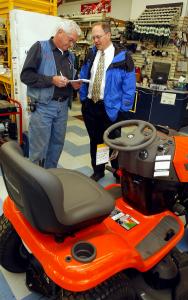
Wayne St. John (left) of the family-run Fireside True Value sold a lawn tractor last week to David Dunn of Dummerston. Wayne St. John (left) of the family-run Fireside True Value sold a lawn tractor last week to David Dunn of Dummerston. (Jason R. Henske/Associated Press)
Email|Print|Single Page| Text size – + By John Curran Associated Press / May 4, 2008

BRATTLEBORO - When a Home Depot set up shop across the street, Fireside True Value hardware store owner Wayne St. John knew it would probably take some of his customers away.

more stories like this

He and his brothers, who've operated their store for 35 years, had heard the stories about big-box stores and their low prices driving competitors into the ground.

So the store stuck to what it does best - good customer service, competitive prices, and a willingness to stock the hard-to-find parts that folks never seemed to find at the big building with the orange roof.

Four years later, it's Fireside True Value that's still standing.

"I've had a lot of customers come in and say 'You guys put them under,' " said St. John.

In truth, many factors played a role in the closing of Home Depot store No. 4552 and in the Atlanta-based home improvement giant's decision to close 14 other "underperforming" stores whose annual sales averaged about $11 million, far below the $36 million desired by the company.

Among them: Opposition from grass-roots groups that succeed in stirring up boycotts and bad publicity even when they don't stop the stores from opening.

"We've seen big-box stores defeated in over 200 communities in the last two years," said Stacy Mitchell, author of "Big-Box Swindle: The True Cost of Mega-Retailers and the Fight for America's Independent Businesses."

"Campaigns are proliferating and even if they don't succeed, the public education they do often has a significant impact on people's shopping choices after the store opens," Mitchell said.

In Brattleboro, an artsy southern Vermont town (pop. 11,741) known for its left-leaning sensibilities, Home Depot was a public enemy before it even opened the store in a former Ames department store 1 1/2 miles from downtown.

Small by Home Depot standards at 60,000 square feet, it was sandwiched in between two other Home Depots - one across the river in Keene, N.H., the other in nearby Greenfield, Mass. - both within a 30-minute drive.

BrattPower, a citizens' group, fought to keep the home improvement retailer out, saying its bargain prices and sheer size would siphon business from local businesses.

"This is not an orange-blooded town," said Al Norman, an antisprawl activist who has spearheaded campaigns against Wal-Mart and Home Depot in dozens of communities.

"Yes, it's a bad housing market. Yes, it was a bad location. Yes, it was a small location. But it was also in hostile territory."

Loyalty to existing businesses also played a role.

Brown & Roberts, a family-operated Ace Hardware store downtown beloved by locals for its creaky wooden floors, peg-board displays, and attentive personal service, couldn't compete with Home Depot's prices on some products, but many customers continued going there anyway.

"That first year, business was flat," said manager Paul Putnam, 59, who runs it along with seven other family members.

"We haven't had a banner year in their four years here, but we've managed to make it. Good customer service, having friendly, knowledgeable employees, that's always been our strong point."

Neither store changed its merchandising strategy or price structure to compete with the new store in town, believing that customers would stick with them. For the most part, they did.

Home Depot spokeswoman Jean Niemi wouldn't comment on the common traits shared by the towns where the stores will be closed. She said the lackluster sales were the bottom line.

_uacct = "UA-1459002-1"; urchinTracker();